Functional Medicine First Appointment Checklist: What to Bring & How to Prep
Nervous about your first functional medicine appointment? This checklist covers exactly what to bring, write down, and ask — so nothing important gets left behind.
On this page Read more
- What Should You Bring to a Functional Medicine First Appointment? (The Quick Answer)
- Why Preparing for a Functional Medicine Appointment Is Part of the Treatment
- What to Bring to a Functional Medicine Appointment: Your Document Checklist
- Build Your Health History Timeline — The Real Game-Changer
- Questions to Ask Your Functional Medicine Doctor
- What to Expect from Functional Medicine Lab Tests on Your First Visit
- What to Expect at Your Functional Medicine Initial Consultation
- The Mistakes That Quietly Sabotage a Good First Appointment
- Key Takeaways
- Frequently Asked Questions
- Your Healing Starts Before You Walk In the Door
Reading time: ~9 min | Last reviewed: July 2026
You booked the appointment.
After months — maybe years — of being told your labs were "normal" while you still felt exhausted, foggy, or quietly falling apart, you finally found someone who wants to dig deeper. That's not a small thing. That took courage.
And here's the part nobody tells you upfront: the quality of your first visit depends almost entirely on what you walk in with.
A functional medicine first appointment isn't a 12-minute rush. It's often 60 to 90 minutes of your practitioner piecing together the full story of your health — and they can only work with what you put in front of them. Show up with fragments, and you'll spend the visit reciting dates instead of getting answers. Show up prepared, and you hand them a map.
This functional medicine first appointment checklist walks you through exactly what to gather, what to write down, and what to ask — so this visit becomes the turning point it's meant to be.
What Should You Bring to a Functional Medicine First Appointment? (The Quick Answer)
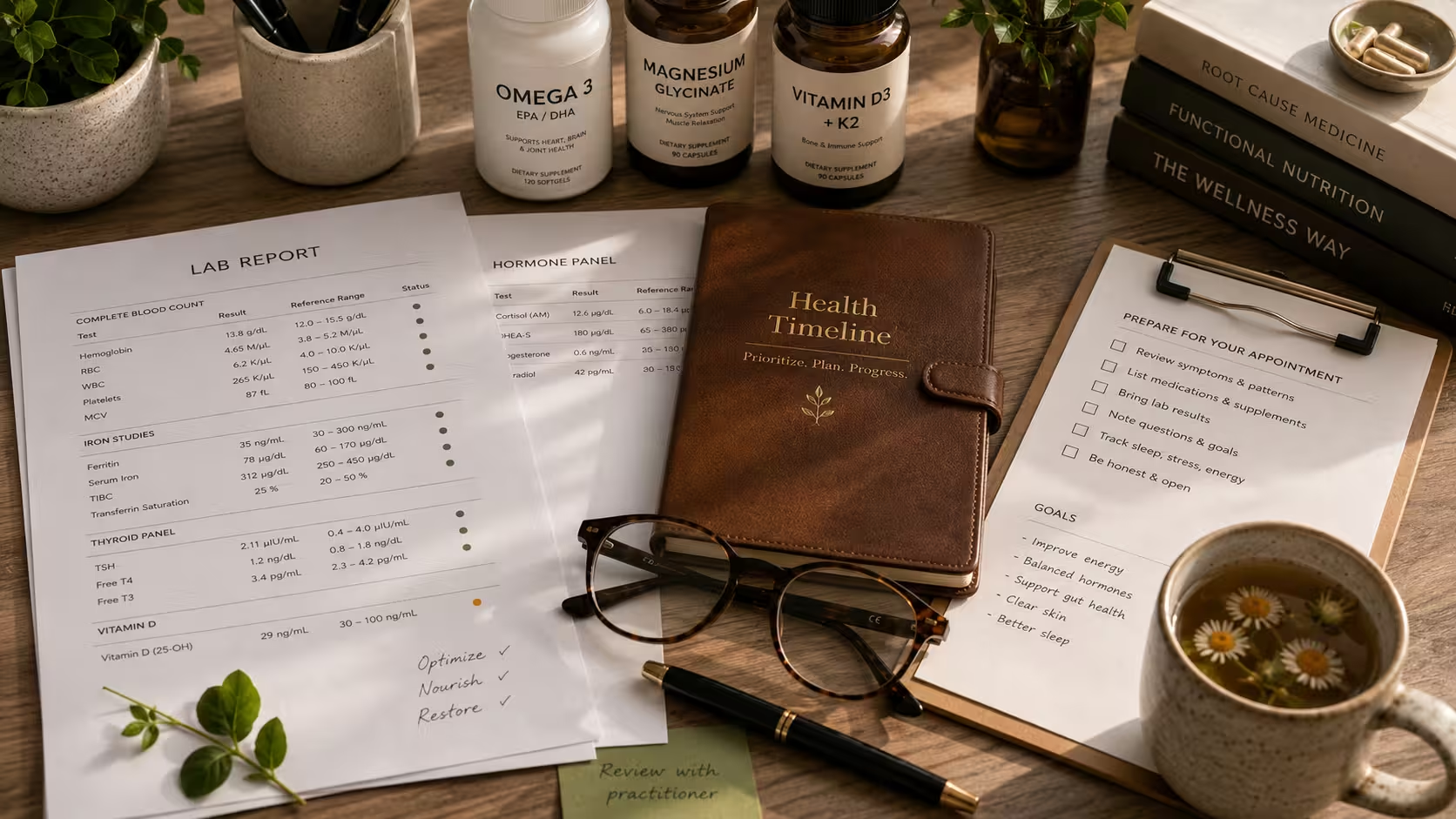
Bring past medical records and all recent lab results (even "normal" ones), a complete medication and supplement list, a one-to-two-week symptom journal, your family health history, and a written health-history timeline of major events. Add a short list of questions. The single highest-value item is your old labs — functional practitioners re-read them against optimal ranges, not just standard ones.
The rest of this checklist breaks each piece down — and shows you how to build the timeline that ties it all together.
Why Preparing for a Functional Medicine Appointment Is Part of the Treatment
In a conventional 15-minute visit, the doctor drives. They ask a few pointed questions, glance at your chart, and move on. Functional medicine flips that.
Your practitioner is doing root cause analysis — looking for the upstream drivers behind your symptoms rather than just labeling and managing them. And that kind of detective work runs on data.
Your timeline. Your old labs. The supplement you've taken for three years. The gut issues that started right after a round of antibiotics in 2019. These are the clues. When the conventional system loses track of them — and it usually does, scattered across portals and providers who never talked to each other — your new provider is starting blind.
The core principle: Your appointment is only as good as the information you bring. Preparation isn't busywork — it's the first real step of your healing.
Good news? Getting ready isn't complicated. It just takes a little intention before you walk in.
What to Bring to a Functional Medicine Appointment: Your Document Checklist
Let's start with what to bring to a functional medicine appointment — the records, forms, and items your provider actually needs. Try to pull these together a few days ahead. You don't want to be scrambling the night before.
- Past medical records and recent lab results. Request copies from every provider you've seen — bloodwork, imaging, biopsies, hospital summaries. All of it. Even your "normal" labs are valuable here, because functional practitioners read them against optimal ranges, not just the wide standard reference ranges. functional lab ranges vs. conventional
- A complete medication list. Name, dose, and how long you've been on each one.
- Every supplement you take. Bring the actual bottles or snap a photo of the labels. Brand, dose, and form matter more than you'd think.
- Insurance info and prior diagnoses. Note which diagnoses were confirmed by testing — versus which were more of an educated guess.
- A symptom journal. Even one or two weeks of notes on your energy, digestion, sleep, mood, and pain reveals patterns a single snapshot can't.
- Family health history. Conditions in parents, grandparents, and siblings — especially anything autoimmune, thyroid-related, cardiovascular, or metabolic.
If you can only do one thing on this list? Gather your old labs. They're the most underused, highest-value thing you can walk in with.
Build Your Health History Timeline — The Real Game-Changer
Here's where functional medicine new patient intake goes deeper than anything you've done in a conventional setting. Your practitioner doesn't just want a list of current complaints.
They want the story.
When did things start? What was happening in your life at the time? What changed — and what didn't?
A functional medicine health history timeline is simply a chronological record of the meaningful events in your health. It sounds simple. But this functional medicine health history timeline is the single most clarifying thing you can prepare before your visit.
Work through your life decade by decade and write down:
- Major illnesses, infections, and hospitalizations — including childhood ones.
- Surgeries and injuries — especially anything needing anesthesia or a long recovery.
- Long courses of antibiotics or medications — these can reshape the gut microbiome in ways that echo for years. the gut healing protocol (5R method)
- Major life stressors — a divorce, a loss, a job that burned you out. Chronic stress drives cortisol shifts that ripple through nearly every system in your body.
- Dietary changes, big weight shifts, or travel — including any food poisoning or illness abroad.
- When each current symptom first appeared — even a rough date counts.
Here's why the sequence matters so much.
I'll call her Maya. On paper, she had three unrelated complaints — bloating, anxiety, and aching joints. Nothing seemed connected. But when she mapped her timeline, all three had appeared within eighteen months of a severe gut infection she'd picked up traveling overseas.
Suddenly, three separate problems became one story.
That connection only emerged because she'd written it down.
The mechanism is worth understanding. When the gut lining becomes permeable — what practitioners call intestinal permeability, or what you may have heard called "leaky gut" — undigested food bits and bacterial fragments can slip into the bloodstream. Your immune system flags them as threats. It mounts a low-grade immune response. And over time, that low-grade, body-wide inflammation can surface as joint pain, brain fog, or anxiety that seems to have nothing to do with your gut.
A timeline makes those invisible links visible. That's the whole point.
Questions to Ask Your Functional Medicine Doctor
You're not a passive patient here. You're a partner. Walking in with a short list of questions to ask your functional medicine doctor signals that you're ready to engage — and it keeps you from leaving wishing you'd remembered the one thing you actually needed to know.
Write these down. Leave space for notes beside them.
- Based on my history, what root causes are you looking at first?
- What functional lab tests will we run — and what is each one looking for?
- How do you tell the difference between a "normal" result and an optimal one?
- What does a realistic timeline for improvement look like for someone in my situation?
- How will we track progress, and how often will we check in?
- What can I start doing right now — with food, sleep, or stress — while we wait on results?
That last question is worth writing down on its own. You don't have to wait for a finished plan before you start supporting your body.
What to Expect from Functional Medicine Lab Tests on Your First Visit
Part of preparing for a functional medicine appointment is knowing that the testing landscape looks nothing like a standard annual panel.
You won't necessarily get every test on day one — your provider will prioritize based on your story and what feels most urgent. But it helps to know what's possible.
Functional medicine lab tests on a first visit may include comprehensive bloodwork, a full thyroid panel (not just TSH), hormone assessments, inflammatory markers, nutrient-status testing, and sometimes gut microbiome or stool analysis. Here's the distinction that changes everything: a standard panel might flag your thyroid as perfectly "fine" because TSH falls inside the broad reference range of roughly 0.5–4.5. Many functional practitioners aim for a much tighter optimal window — often around 1.0–2.0 — and read it alongside Free T3, Free T4, and thyroid antibodies.
That gap between normal and optimal? That's exactly where so many people have been falling through the cracks for years. functional lab ranges vs. conventional
And it's exactly why bringing your old labs matters. Your provider can re-read results you were told to stop thinking about.
What to Expect at Your Functional Medicine Initial Consultation
Knowing the rhythm of the visit takes a lot of the pressure off. Here's how a functional medicine initial consultation usually unfolds:
- Before you arrive: Most practices send detailed intake forms in advance. Budget 30–60 minutes to fill them out fully and honestly. This truly is part of your appointment — not an admin formality.
- During the visit: Expect a deep, easy-going walk through your full timeline — lifestyle, diet, sleep, stress, environment, relationships. It can feel surprisingly personal. It's supposed to.
- When you're wrapping up: You'll likely leave with a testing plan and some initial steps, not a finished diagnosis. Functional medicine unfolds across follow-up visits as results come in and the picture gets clearer.
If you arrive expecting a quick answer, the pace can feel slow.
If you arrive knowing you're starting a process of uncovering root causes — and that this visit is the beginning, not the end — it feels a lot closer to relief.
The Mistakes That Quietly Sabotage a Good First Appointment
Even motivated, well-prepared people get tripped up on the same predictable things. Sound familiar?
- Leaving labs at home because you assume they're "all normal." They're often the most revealing piece your provider will see all day.
- Editing your own story — minimizing symptoms, skipping the embarrassing ones, softening just how stressed you've really been. Your doctor can't connect dots you hide.
- Forgetting supplements and over-the-counter habits. That daily ibuprofen? The magnesium you've taken for two years? The nightly glass of wine you didn't mention? It all matters.
- Expecting answers on day one. Real root cause work is iterative. Patience isn't optional — it's part of the protocol.
Key Takeaways
- Your first visit is only as good as what you bring — preparation is the first step of treatment, not busywork
- Gather your old labs first; they're the highest-value, most underused item, and functional practitioners re-read them against optimal ranges
- Build a decade-by-decade health history timeline — the sequence of events reveals connections a symptom list hides
- Bring the full picture: records, medications, actual supplement bottles, a symptom journal, and family history
- Walk in with written questions, including "what can I start today while we wait on results?"
- Expect a 60–90 minute conversation and 30–60 minutes of intake forms — plus a testing plan, not an instant diagnosis
- Don't edit your own story or leave "normal" labs at home — those are the two most common self-sabotages
Frequently Asked Questions
What should I include on a functional medicine first appointment checklist?
How is a functional medicine initial consultation different from a conventional appointment?
What lab tests might be ordered at a first functional medicine visit?
How do I put together a health history timeline for my appointment?
How long does the functional medicine new patient intake process take?
What questions should I bring to my first functional medicine consultation?
Your Healing Starts Before You Walk In the Door
You finally found someone willing to look deeper. That's not nothing. But this opportunity is only as powerful as the preparation you bring with you.
Your old labs. Your honest timeline. Your written questions. These are what turn a long appointment into a genuine turning point.
You don't have to do this perfectly. Pull together what you can, write down what you remember, and walk in ready to tell your whole story. Your body has been trying to get your attention for a long time.
This is the appointment where someone finally listens. Make sure you give them everything they need to hear.
Ready to walk in fully prepared? Download the free printable Functional Medicine First Appointment Checklist (PDF) and tick off each item before your visit — so nothing important gets left behind.
First Appointment Checklist
Get prepared for your first functional medicine visit with this checklist.
Download PDF FreeFact Checked By Dr. Prerana Suryavanshi, MD, MBBS
This medical analysis has been peer-reviewed and vetted by a credentialed practitioner to ensure diagnostic safety.

Written by Dr. Pooja, PharmD
Dr. Pooja didn't set out to write about gut health and hormones. She set out to become a pharmacist — learning how drugs move through the body, why they interact the way they do, and what it actually takes to prove a treatment works. That training is still the lens she writes through today.
View all articles by Dr. Pooja